

Bet You Didn’t Know Hearing Loss Leads To This!
We live in a society surrounded by sounds and noises pretty much 24*7. Take a stroll through the streets and you will see people walking around with headphones and earphones, listening to music or having a conversation on their mobile phone. Walk past shops and different music blends into a never-ending sound-mix, blaring from loudspeakers. Cinemas, pubs and dance clubs pump up the volume as customers lap it all up as sensory pleasure.
Noisy Surrounding
Sound has taken on a full frontal role in our daily life. Home TVs now come with soundbars and home appliances such as vacuum cleaners, blenders, coffee machines generate a lot of noise when operated. Even doing healthy activities like exercising in a gym or working in the garden often subject our ears to high decibels, without us being conscious of risks. Or if we are aware, we accept it as a trade-off for enjoyment, efficiency or productivity. It is no wonder that more people are suffering from auditory problems such as loss of hearing and tinnitus.

Hearing Loss
And so is the case for my Dad, who started to be hard of hearing 3-4 years ago. It became increasingly obvious as he starts to turn up the volume on the TV and often needs us to repeat what we say. A recent incident related by my mum highlighted how dangerous it can be. My Dad was trying to filter to another lane to exit from the highway but could not hear the honk of a car that was in his blind spot. Luckily the other driver reacted in time and no accident occurred but it could have been otherwise.
So when I was in Singapore recently, I persuaded him to go to an audiologist for a hearing test. Besides being quite annoying to keep repeating our conversation and having to watch TV at a loud volume, it can be dangerous like the driving incident. Sitting through the 2-hour consultation, I learned enough about hearing loss to be alarmed by the health implication.
Living With Hearing Loss
Beyond annoyance and inconvenience, hearing loss has huge impact on the quality of one’s life. For people with hearing loss, it takes more effort to listen, and it can be embarrassing sometimes so some sufferers withdraw from interaction. This leads to social isolation and in some cases even depression.
Approximately 1 in 3 people between the ages 65 and 74 has hearing loss and nearly half of those older than 75 has difficulty hearing.
~ National Institute of Aging
I could identify such behaviour in my Dad as the audiologist described them. He is less participative in our conversations and has started rejecting invitation to go out with his friends, something he used to enjoy and look forward to. Sometimes he guesses the context of our conversation based on the surrounding and activities and makes the wrong remarks or gives the wrong response, which is frustrating.
And the most alarming fact I learnt about hearing loss? That it increases the chance of dementia. Hearing loss is increasingly believed to be 1 of the top causes for dementia, with more studies confirming the causality.

Hearing Loss And Dementia
How is hearing loss connected to dementia?
When someone is hard of hearing, the brain becomes less stimulated as it receives less auditory signals and hence generate less reaction. Everyday, unbeknownst to us, our ears detect and process thousands of sound waves into electrochemical impulses which are then transmitted to our brain for interpretation.
This auditory deprivation leads to less brain activity and some of the brain cells – known as neurons – start to die or loose connection with other neurons. This phenomenon is called brain (cerebral) atrophy and happens because the neutrons are no longer in use. Our body is built to work efficiently, adhering very much to the concept of ‘Use it or Loose it’. Once brain cells die or lose their connections, it is irreversible.
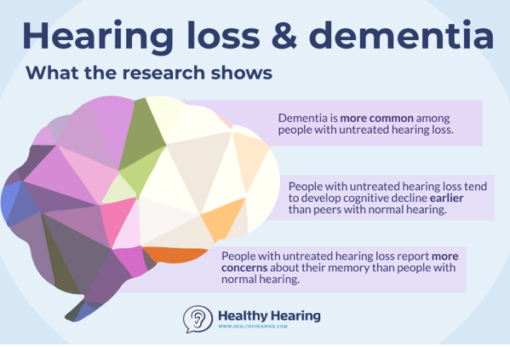
That hearing loss can lead to dementia was a scary revelation for me. It jolted me to the importance and prudence of take hearing loss as a serious health problem than just an annoyance or inconvenience.
Dementia is a dreaded disease that robs sufferers of their dignity by destroying their basic sense of being human, ie thinking. For if “I think , therefore I am’ then what becomes of one who can no longer think? That is why dementia is sometimes called ‘living death’.
What is even more worrying about hearing loss is that it happens gradually and does not cause pain or discomfort. So the only way is to clue in to behaviours such as turning up volume of the TV or asking for questions to be repeated.

Simple Solution
Thankfully, hearing aids offer a straightforward solution as they enable the ears to receive, convert and transmit sound waves to the brain again, preventing neurons from dying due to lack of use. I now have new respect for hearing aids: that such a device can help one hear again and arrest the deterioration of the brain is nothing short of amazing.
As I write this, my Dad is waiting for a pair to be customised for him. He wore a trial set for a week and was very pleased with it. He now looks forward to getting his own pair so he can fully participate in life again.
Hearing loss does not just affect the older population. Younger people are also at risk due to unsafe hearing practices such as listening to loud music from headphones and earphones, spending hours at the gym, cinema or dance clubs.
Over 1 billion young adults are at risk of permanent, avoidable hearing loss due to unsafe listening practices. ~ World Health Organisation.
Isn’t it disturbing that something as ubiquitous as hearing, which most of us take for granted, can lead to cognitive decline and dementia?
Now that you know what tell-tale signs to look out for, be alert not just for yourself but also for those around you. Perhaps more importantly, start to practise safe listening habits. Do share this piece if you have learnt something important, as it may help someone prevent dementia as a result of hearing loss.
Hear ye, hear ye!
Savvy Maverick
(Main image: Dan Freemen, Unsplash)
Disclaimer: The views expressed here are drawn from my own experiences and do not constitute financial advice in any way whatsoever. Nothing published here constitutes an investment recommendation, nor should any data or content be relied upon for any investment activities. It is strongly recommended that independent and thorough research be undertaken before making any financial decisions, including consulting a qualified professional.

2 thoughts
Hi,
Juist read your column about hearing loss and that it increases your chances to get dementia. Oeps, that was confronting, because I also suffer from it (a milder version) but it is nevertheless a huge obstacle in everyday life. I’m now wearing a hearing aid for 3 years now, but to be honest it was very confronting at first. You feel so old!
But now I’m accustomed to it and I cannot care less if someone recognises, haha.
Hope you are both doing well. X ildiko
Hi Ildiko,
Thanks for sharing your story! It was a huge surprise for me to learn that hearing loss can lead to dementia too. Very sensible of you to have started wearing hearing aids, and what a good attitude not to be bothered by what others think. Health and well-being above all else. I hope your story encourages others encountering the same problem to take the steps towards protecting not just their hearing but also brain health.
We are both good, hope to see you soon!
Cheers, Savvy